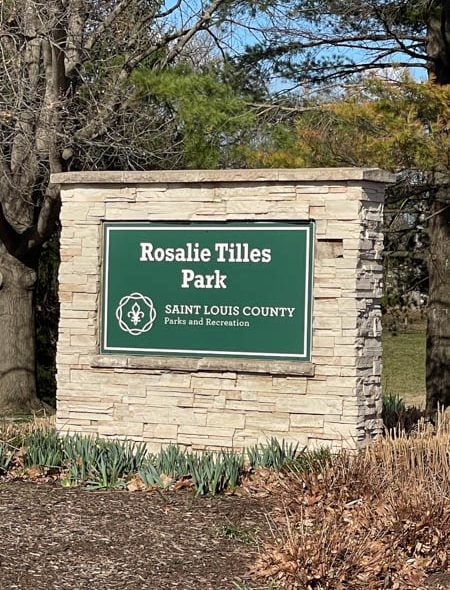
Walk into Tilles Park on a Tuesday evening in late September and you will hear paddles before you see anyone. Six pickleball courts sit where four tennis courts used to run, freshly striped, mostly full. A hundred yards off, discs sail between mature oaks toward baskets that will disappear again by winter. Somewhere past the tree line, a walker is doing laps on the fitness trail, the kind of loop you do twice without really deciding to. None of this looks like the park most people know. The park most people know involves a car, a $20 bill, and a line of headlights waiting for the gates to open on Winter Wonderland. That park exists too. It just hasn't arrived yet.
Tilles Park runs on two calendars, and for most of the year, the one people talk about is the wrong one.
Four Tennis Courts Became Two Tennis Courts and Six Pickleball Courts
The most concrete evidence of the park's working season sits at its center. St. Louis County converted the old tennis layout, taking the site from four tennis courts down to two, and adding six dedicated outdoor pickleball courts with their own lines and nets. The current St. Louis city parks listing for Tilles Park still shows both sports on the amenities sheet, tennis and pickleball side by side, which is the quiet way a park's usage patterns get written into its infrastructure.
Before the conversion | After the conversion |
|---|---|
4 tennis courts | 2 tennis courts |
0 pickleball courts | 6 pickleball courts |
That is not an expansion. It is a reallocation, and reallocations tell you more about how a place is actually being used than a ribbon-cutting for something brand new ever does.
Eighteen Holes Nobody Advertises
Fewer people know that the same 75 acres also hold a full 18-hole disc golf layout, listed with the Professional Disc Golf Association as a technical, advanced course threading through the park's historic tree canopy. It is marked as a temporary course, meaning the baskets go up and come down rather than sitting as permanent fixtures, which explains why it doesn't show up on the park's printed amenity brochures the way the ball fields and courts do. If you've walked past a disc golf basket at Tilles Park and wondered whether you imagined it, you didn't. It's there for exactly the stretch of year when the park belongs to people on foot rather than people in cars.
Built by the WPA, Almost Sold to Developers
The park's working-season identity has deeper roots than this year's court conversion. Cap A. Tilles, a St. Louis businessman, donated the land in 1932 in memory of his mother, Rosalie Tilles, and the Works Progress Administration built out the original facilities starting in 1938, part of the New Deal-era construction boom that shaped so many Depression-era parks in the region. The park was listed on the National Register of Historic Places in 2018, a designation that recognizes how much of that original WPA-era design survives intact.
It almost didn't. By the mid-1950s, a study concluded the city needed more open park space elsewhere, and in 1956 the City of St. Louis moved to sell Tilles Park to developers. St. Louis County stepped in, and on April 17, 1957, the county council voted 4 to 3 to buy the park rather than let it go, paying roughly $429,000 to keep it public. The city, having sold its stake, built an entirely separate park under the same name on Hampton and Fyler in the city, which is why anyone searching "Tilles Park" online sometimes lands on two unrelated places. The one in Ladue, at Litzsinger and McKnight, is the one with the courts, the disc golf, and the oaks that predate all of it.
The One-Mile Loop Between Sports
Between the organized courts and the disc golf, the park's fitness trail does the quieter work of daily use. The full loop covers roughly a mile, and the county's own trail guidance notes that doing it twice makes for a two-mile walk, the kind of distance that fits neatly into an evening before dinner or a Saturday morning before anyone else is out. The trail winds past the park's lake and under the same mature tree cover that makes the disc golf course technical rather than wide open, so the walking route and the disc golf route share real estate without really competing for it. This is the version of the park that has nothing to do with tickets, gates, or a printed schedule. It's just there, seven days a week, for whoever wants it.
When the Park Changes Hands Again
None of this working season lasts. Sometime around the Wednesday before Thanksgiving, the courts and the disc golf baskets give way to the park's other identity, the one it's actually known for outside Ladue. Winter Wonderland, the drive-through holiday light display that has run at Tilles Park since the mid-1980s, takes over the same grounds where the pickleball games were happening weeks earlier. Cars enter from the McKnight Road gate, follow a one-way route through more than a hundred illuminated displays, and exit onto Litzsinger, paying $20 per vehicle in cash at the gate. The display typically runs through the end of December, and by the time it wraps, the park has spent roughly five weeks as a spectacle rather than a place you move through on your own two feet.
The trade-off is the whole story. For most of the year, Tilles Park asks you to get out of the car. For about five weeks, it asks you to stay in it. Both versions draw people to the same 75 acres, just in completely different postures, and the gap between them is wider than most people who've only done the December drive-through would guess.
If you've only ever experienced Tilles Park through a windshield in December, the pickleball courts and the disc golf baskets are worth a visit before the season turns. The park earns its reputation twice a year, in two entirely different ways, and right now it's still in the version most people miss.
Ladue rewards this kind of attention to detail, in its parks and in nearly everything else about the community. If you're curious what other small shifts are shaping daily life in this neighborhood, Alison Sheehan is always glad to talk it through. Let's Connect.