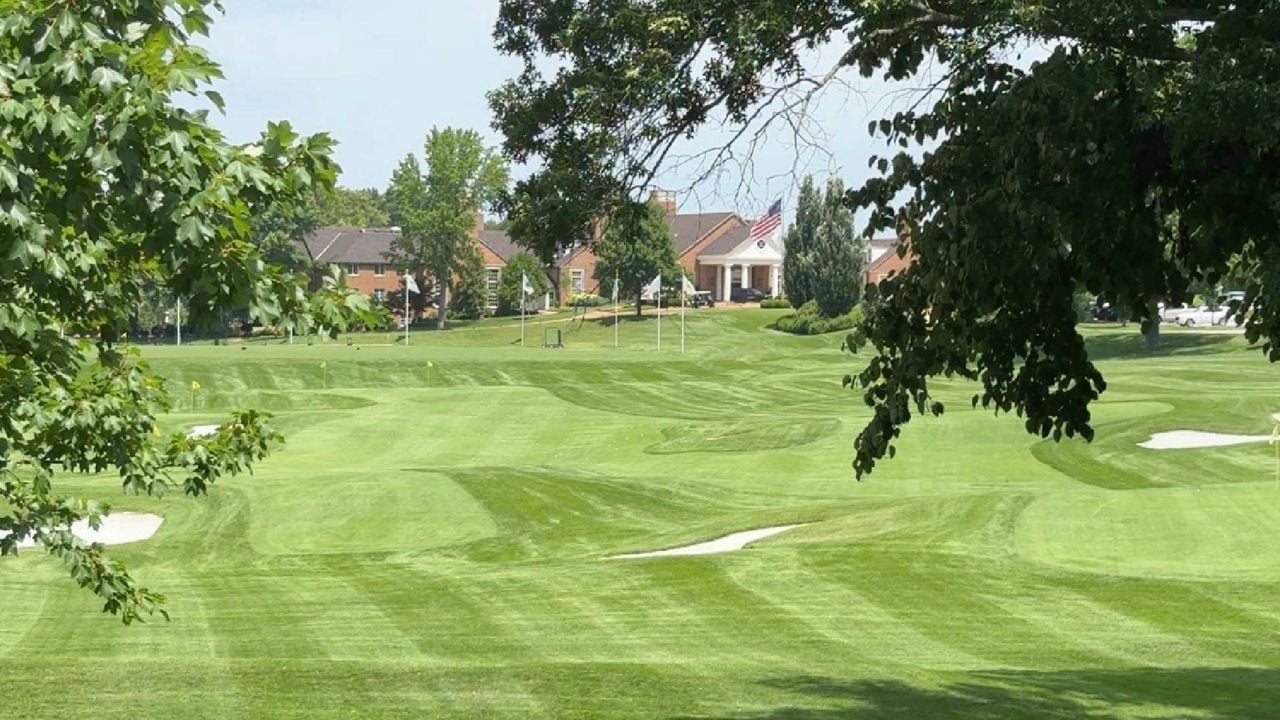
As Yahoo Sports reported, one spectator drove in from Union on the tournament's opening Thursday. A few rows over, another had flown in from South Korea and left with an autograph from Sungjae Im, one of his favorite players. Overhead, two A-10s from the 303rd Fighter Squadron out of Whiteman Air Force Base ran a flyover before Generald Wilson sang the national anthem. For one week in late August, Bellerive Country Club held all of that at once, plus fifty of the best golfers on the PGA Tour, plus a neighborhood of homeowners rerouting their commutes around it.
If you live in Town and Country, you already know the week I'm describing. What's less obvious, unless you've watched Bellerive's calendar for a while, is that this wasn't a novelty. It was a rehearsal for something the club has now done so many times that the choreography barely changes. Bellerive didn't just host a golf tournament this August. It ran a drill it's been refining since 1965, and it already has the next one scheduled.
A Week the Neighborhood Has Rehearsed Before
For the run of the tournament, a stretch of Ladue Road between Highway 141 and Interstate 270 closed to through traffic every morning at 6 and stayed closed well into the evening. Mason Road shut down between Conway and Hibler. Chaselle Lane and Laduemont Drive lost through access entirely. If you lived in Bellerive Country Club Grounds or Bon Chateau, you kept your Ladue Road access. Everyone else in the affected subdivisions got routed through Conway Road instead, with a mailed hangtag to prove you belonged there.
None of that was improvised. It's the same basic playbook Town and Country and Creve Coeur police have used for Bellerive's previous major championships, adjusted for whichever roads happen to border the course that decade. Spectators never had the option of parking at the club at all. Instead, tournament organizers shuttled fans in from the Family Arena in St. Charles, and rideshare traffic got funneled to a single drop-off point at Whitfield School on South Mason Road, directly across from the course. By Thursday of tournament week, Bellerive officials said the complimentary spectator lots were nearing capacity, an outcome they called unprecedented and asked fans to start carpooling for the weekend.
The players in the field told their own version of the recurring story. Rory McIlroy, Justin Rose, Xander Schauffele and Adam Scott had all played Bellerive before, back in 2018. Scottie Scheffler arrived as the defending BMW Championship winner and the tournament's top-ranked entrant. For a course that supposedly sits in a quiet St. Louis suburb, an awful lot of familiar names kept showing back up.
The Résumé That Explains the Pattern
Bellerive's history helps explain why none of this is really surprising. The club started in 1897 as a nine-hole course with 166 members in north St. Louis, incorporated under its current name in 1910, and took its name from Louis St. Ange de Bellerive, the last French commander in North America. When the club's membership decided to move west with the growing metro area in the 1950s, they hired Robert Trent Jones Sr. to design a new course. It opened on Memorial Day in 1960 and picked up a nickname that's stuck ever since: the Green Monster of Ladue.
What that course has hosted since then is the actual point. Gary Player made history there at the 1965 U.S. Open. The club held the U.S. Mid-Amateur in 1981, the PGA Championship in 1992 (Nick Price won), the U.S. Senior Open in 2004, the BMW Championship in 2008, the Senior PGA Championship in 2013, and the PGA Championship again in 2018, where Brooks Koepka closed at 16 under to win. This August's BMW Championship was Bellerive's eighth major championship.
Look at the spacing and something shifts. During the club's first three decades as a championship host, the gaps ran long: eleven years between the 1981 Mid-Amateur and the 1992 PGA Championship, twelve more to the 2004 U.S. Senior Open. Then the wait started compressing. Four years to the 2008 BMW Championship. Five more to the 2013 Senior PGA Championship. Another five to the 2018 PGA Championship. This year's return took eight years, longer than that recent run, but the club has already closed the gap again. The 2030 Presidents Cup arrives just four years after this year's BMW Championship, tying the shortest stretch Bellerive has ever managed between championships.
By Friday, It Was Just the Club Again
The part that might actually surprise you if you weren't watching closely is how fast the whole production disappears. Bellerive's PGA Director of Golf, Mike Tucker, put it plainly to a FOX 2 crew covering the teardown: the infrastructure comes down in about half to a third of the time it took to build. "It's a little more frantic coming down, because you don't have to be so careful," Tucker said. "So, there are machines and trucks and forklifts flying around right now."
The course itself bounced back even faster than the grandstands did. Tucker noted that the areas inside the ropes, the fairways, greens and bunkers, were already in strong shape once the tournament wrapped, since that's where the tightest maintenance attention goes during the event. It's the areas outside the ropes, where thousands of spectators walked all week, that need time to recover. Even so, Bellerive's members were back on the course the Friday after the tournament ended. Tucker said they were excited to play.
That turnaround matters more than it might seem. A neighborhood that hosted a nationally televised PGA Tour event, closed two of its main arteries for the better part of a week, and rerouted an entire subdivision's traffic pattern was functionally back to itself within days. The disruption was real while it lasted. It also wasn't designed to last.
What This Actually Means If You Live Here
If you've been in Town and Country long enough to remember 2018, this August probably felt familiar in a way that a first-time host city never could. The road closures follow a known pattern. The Whitfield School rideshare pickup, the Family Arena shuttle, the subdivision-specific hangtags: all of it has been done before, refined each time, and will likely get pulled back out with minor tweaks in 2030. That's a different kind of neighborhood texture than most suburbs offer. It's not just proximity to a golf course. It's proximity to a golf course that keeps getting chosen by the sport's biggest events, on a schedule that's now measured in years rather than decades.
For residents, that means the next disruption is already on the calendar, four years out, and everyone who lived through this August will have a pretty good idea of what to expect when it arrives. The traffic will be real. The neighborhood will absorb it. And the members will probably be back on the course within a week of the trophy being handed out.
If you're weighing what it actually means to live somewhere with this kind of recurring national spotlight, or you're curious how a street like Ladue Road holds its value through a week like this one, Alison has spent years watching how Town and Country absorbs moments like the BMW Championship and comes right back to itself. Let's Connect.